
When your designing high frequency PCBs, one of the first decisions you gotta make is what material to use. The choice between Rogers Laminates and standard FR4 isn't always straightforward - it depends on your frequency requirements, budget constraints, and performance expectations. Making the wrong choice can mean wasted money, failed designs, or boards that don't perform as expected.
In this article, we'll break down the real differences between Rogers and FR4 materials for high frequency applications. We'll look at electrical properties, thermal behavior, processing considerations, and cost factors. By the end, you should have a clear understanding of when each material is the right choice - and when spending extra on Rogers is worth it versus when FR4 is perfectly adequate.
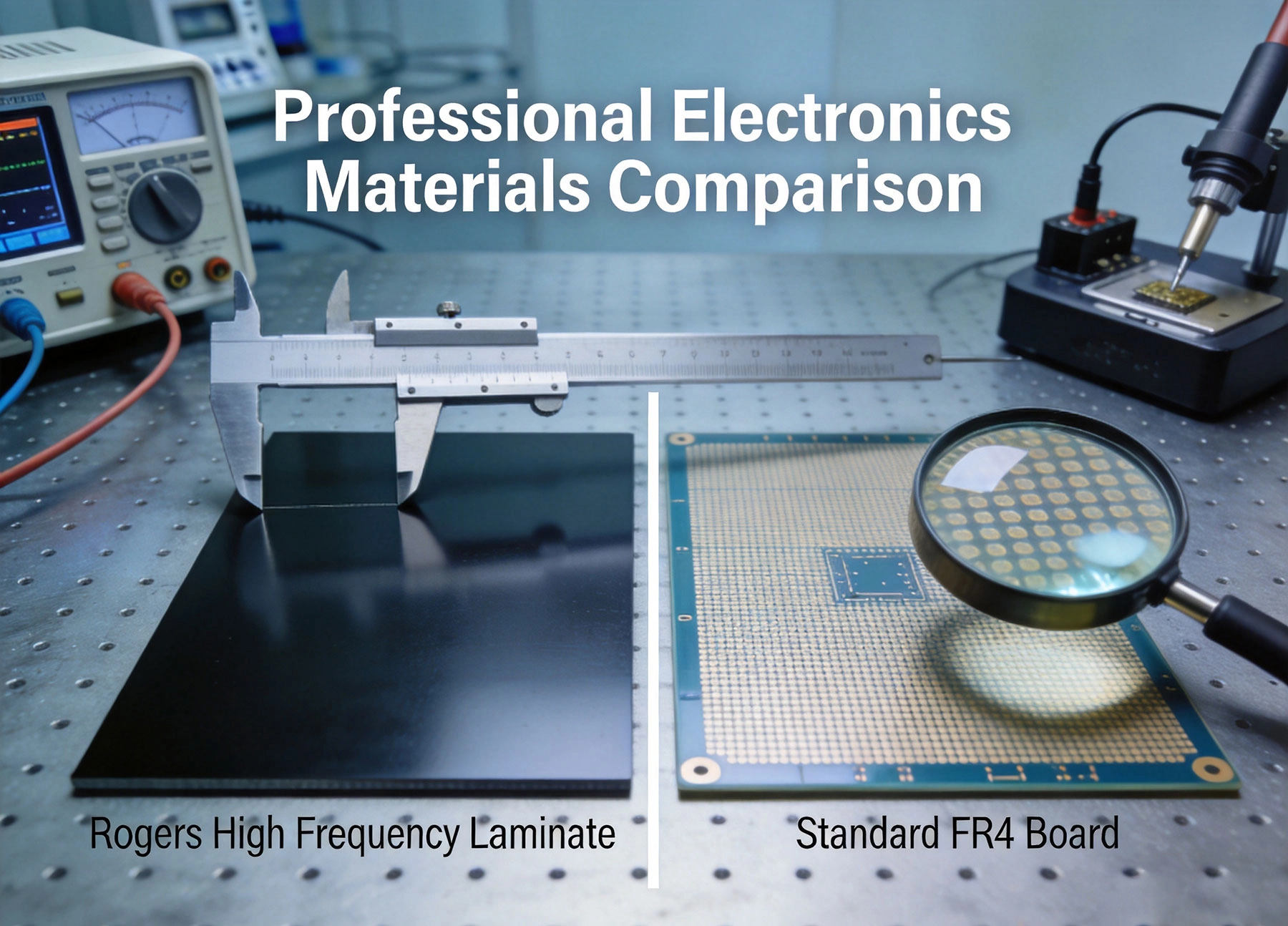
FR4 is the workhorse of Pcb Manufacturing. It's been around for decades, virtually every PCB fabricator knows how to process it reliably, and it's relatively inexpensive. But FR4 wasn't designed for high frequency applications - it was developed as a general-purpose material with good mechanical properties, reasonable electrical characteristics, and flame retardancy (that's what FR stands for).
FR4 typical properties:
The main issue with FR4 for high frequency work is the loss tangent. At 0.015-0.025, FR4 absorbs a significant amount of signal energy as heat. This loss increases with frequency, making FR4 problematic above certain frequency thresholds. For many applications, this loss is acceptable - but for demanding RF work, it's a performance killer.
FR4 ain't useless for RF - it just has limitations you need to understand. For frequencies below 1-2 GHz, FR4 often works just fine. Many WiFi routers, Bluetooth devices, and basic Rf Circuits use FR4 successfully. The key is knowing when the loss is tolerable versus when it'll cause problems.
Applications where FR4 is appropriate:
I've seen designs fail because someone automatically chose Rogers without checking if FR4 would work. Spending extra money on High Frequency Materials when FR4 would suffice isn't good engineering - it's wasteful. The key is understanding your actual requirements, not just assuming you need the best available material.
Rogers Corporation develops laminate materials specifically for high frequency applications. Their materials are engineered to minimize loss and maintain stable electrical properties across frequency ranges. This specialized development makes Rogers materials perform better than FR4 at high frequencies, but it also makes them more expensive and sometimes harder to fabricate.
Rogers material families:
Each Rogers material family has different characteristics suited to different applications. Understanding these differences helps you select the right material rather than just choosing "Rogers" generically.
The RO4000 series is probably the most commonly used Rogers material for general high frequency PCB work. These materials offer significantly better loss characteristics than FR4 while remaining reasonably processable by standard fabrication equipment.
RO4000 series properties:
RO4000 materials use a hydrocarbon ceramic formulation that gives them better thermal stability than PTFE-based materials while still providing low loss. Most PCB fabricators can process RO4000 materials without major process changes, though some parameter adjustments are needed.
For the most demanding applications, RO3000 series materials provide lower loss than RO4000. These are PTFE-based materials with ceramic fillers that achieve loss tangents below 0.002. However, PTFE-based materials are trickier to fabricate and more expensive.
RO3000 series properties:
RO3000 materials are typically used for microwave applications, Satellite Communications, radar systems, and other demanding RF work where every dB of loss matters. The fabrication challenges and higher cost make them overkill for less demanding applications.
The Dielectric Constant affects how signals propagate through your PCB and determines trace dimensions for target impedances. Both FR4 and Rogers materials have Dk values, but they behave differently across frequency and temperature.
Dk behavior differences:
For narrowband applications at a single frequency, Dk variations might not matter much. But for broadband or multi-frequency applications, stable Dk performance is important. Rogers materials maintain consistent impedance across frequency ranges where FR4 shows significant variation.
This is where the real difference shows up. Loss tangent determines how much signal energy gets absorbed as heat during transmission. The difference between FR4 at 0.02 and Rogers at 0.002 might seem small, but it translates to significant dB differences in Signal Loss, especially for longer Transmission Lines.
Loss comparison example:
Consider a 10-inch Transmission Line at 5 GHz:
That 2+ dB difference matters a lot in many applications. For a receiver front-end, that's a significant sensitivity reduction. For a power amplifier output, that's wasted power heating the board instead of radiating from the antenna. The cumulative effect becomes even more significant for longer traces or multiple signal paths.
Coefficient of thermal expansion (CTE) affects reliability during thermal cycling. Components and Pcb Materials expand at different rates when heated, creating mechanical stress at interfaces. FR4 and Rogers materials have different CTE characteristics that affect long-term reliability.
CTE comparison:
The through-thickness CTE matters most for via reliability and component solder joints. FR4's high through-thickness CTE can cause via cracking or pad delamination during repeated thermal cycling. Rogers materials with better controlled CTE show improved reliability in demanding thermal environments.
Moisture absorption affects both electrical performance and reliability. Water absorption increases Dk and Df, changing impedance and increasing loss. It also contributes to popcorning during rapid heating (like soldering) and reduces long-term reliability.
Moisture absorption rates:
For applications in humid environments or where boards experience temperature swings, moisture absorption matters. Rogers materials generally show better moisture resistance than FR4, contributing to more stable performance and better reliability.
FR4 can be fabricated by virtually any Pcb Manufacturer. Rogers materials require fabricators with specific experience and capability. Not every PCB shop can process Rogers materials reliably, which affects lead times, cost, and sourcing options.
Fabrication availability comparison:
If you need boards quickly or have limited fabrication partner options, FR4 availability advantage is significant. For prototype iterations where quick turnaround matters, FR4 might be worth using initially even if final production will use Rogers.
PTFE-based materials like RO3000 are more challenging to process than hydrocarbon materials like RO4000. PTFE's softness and thermal behavior require specific drilling parameters, controlled lamination processes, and careful handling. Fabricators without PTFE experience often have quality problems.
Processing difficulty levels:
Process difficulty translates to cost - fabricators charge more for materials that are harder to work with. It also affects reliability if the fabricator lacks proper experience. Choosing a material your fabricator can't handle well leads to quality problems regardless of material specifications.
Rogers materials cost significantly more than FR4. The exact difference depends on specific materials, quantities, and suppliers, but Rogers materials typically cost 3-10x more than equivalent FR4 laminate.
Approximate cost comparison:
These material costs translate to higher board prices. For low-volume production, the cost difference might be manageable. For high-volume consumer products, using Rogers might make the product economically unfeasible. The cost trade-off needs careful analysis against performance requirements.
Material cost ain't the whole story. Total cost includes fabrication charges, yield losses, and potentially redesign costs if initial material choices don't work. Sometimes spending more on materials saves money overall by preventing failures and redesigns.
Total cost factors:
For critical applications, the performance value might far exceed material cost differences. A design that fails with FR4 but succeeds with Rogers is worth the extra material cost. The key is understanding whether your application actually needs that performance.
Frequency is a primary factor in material selection. Higher frequencies increase loss and make stable Dk more important. Different frequency ranges suggest different material choices.
Frequency-based recommendations:
These are guidelines, not absolute rules. Specific applications might have different loss tolerance or performance requirements. But frequency gives a starting point for material consideration.
Beyond frequency, application requirements determine whether material cost is justified. Consumer products, industrial equipment, aerospace systems, and research applications all have different acceptable cost-performance trade-offs.
Application-based recommendations:
Application context also affects other factors like reliability requirements and acceptable risk. A failed consumer product gets returned; a failed aerospace system can have much more serious consequences. Material choice should reflect these differences.
For development projects, it often makes sense to start with FR4 for initial prototypes and transition to Rogers for refined designs. This approach reduces development cost while still achieving final production performance.
Iterative material strategy:
This strategy works when basic functionality can be tested with FR4 and performance limitations won't prevent meaningful prototype evaluation. For designs where RF performance is fundamental, starting with Rogers may be necessary.
Material selection should involve your fabrication partner early. Their capability with specific materials, process experience, and cost structure affect the practical material choice. A material that looks perfect on paper might not work with your available fabricators.
Questions for fabrication partners:
Fabricator input often reveals practical considerations that material datasheets don't address. A fabricator might recommend a specific Rogers material based on their capability and experience, or suggest that FR4 will work for your application when you expected Rogers to be necessary.
Choosing between Rogers and FR4 ain't about automatic selection of the "better" material. It's about matching material characteristics to application requirements while considering cost, availability, and fabrication practicality.
FR4 works fine for many applications below a few gigahertz. It's inexpensive, universally available, and reliably fabricated. Rogers materials provide lower loss and better stability for demanding RF applications, but at higher cost with fabrication constraints.
The decision framework we've outlined - frequency-based, application-based, and considering practical factors like fabrication availability and total cost - provides a structure for making informed choices. Apply this framework to your specific requirements, consult with fabrication partners about practical considerations, and make material choices that balance performance needs against real-world constraints.
Smart material selection means using FR4 when it's adequate and Rogers when it's necessary. Understanding the differences we've covered helps you make that distinction confidently, avoiding both unnecessary expense from over-specification and performance failures from under-specification.
If you're designing high frequency PCBs and need guidance on material selection, we can help. Our technical team understands both FR4 and Rogers materials, their processing requirements, and their application fit. We'll help you analyze your requirements and select materials that deliver the performance you need at costs your project can sustain.
Contact us to discuss your material requirements: We'll review your frequency needs, application constraints, and production plans to develop material recommendations that work for your specific situation.
Q: Can I mix FR4 and Rogers materials in the same PCB?
A: Yes, mixed material stack-ups are possible. However, careful design is needed to manage CTE differences and ensure Signal Integrity across material transitions. Consult with fabricators experienced in mixed material boards.
Q: What happens if I use FR4 above 5 GHz?
A: FR4 loss increases significantly above 5 GHz, potentially causing 3-5 dB or more loss per inch of Transmission Line. This may be acceptable for some applications but problematic for others. Test structures can help evaluate whether FR4 works for your specific design.
Q: Are there materials between FR4 and Rogers in cost and performance?
A: Yes, materials like Isola I-tera, Panasonic Megtron, and other high-performance FR4 variants offer better loss than standard FR4 at moderate cost increases. These materials bridge the gap between FR4 and Rogers for some applications.
Q: How do I verify that my material choice will work?
A: Design test structures alongside your production circuit. Test structures let you measure actual insertion loss, impedance, and other parameters before committing to full production. Work with fabricators who can provide electrical test data.
Q: Does Rogers material always mean better performance?
A: Not necessarily. Rogers materials have better specifications, but actual performance depends on fabrication quality and design optimization. Poor fabrication of Rogers material might not achieve the performance good fabrication of FR4 delivers. Material selection is just one factor.
The Impact of Copper Foil Type on High Frequency PCB Materials PerformanceSeptember/16/2026
High Frequency PCB Materials for Automotive Radar: Durability and SpeedSeptember/26/2026
Understanding Thermal Stability in High Frequency PCB MaterialsAugust/10/2026

Top 5 High Frequency PCB Materials for 5G Base Station ApplicationsJuly/30/2026
Cost vs. Performance: Selecting Budget-Friendly High Frequency PCB MaterialsSeptember/04/2026
Rogers vs. FR4: Choosing the Right High Frequency PCB MaterialsJune/12/2026
The Ultimate Guide to High Frequency PCB Materials: PTFE, Ceramic, and HydrocarbonJuly/08/2026
How Dielectric Constant (Dk) and Loss Factor (Df) Affect High Frequency PCB MaterialsJuly/18/2026